
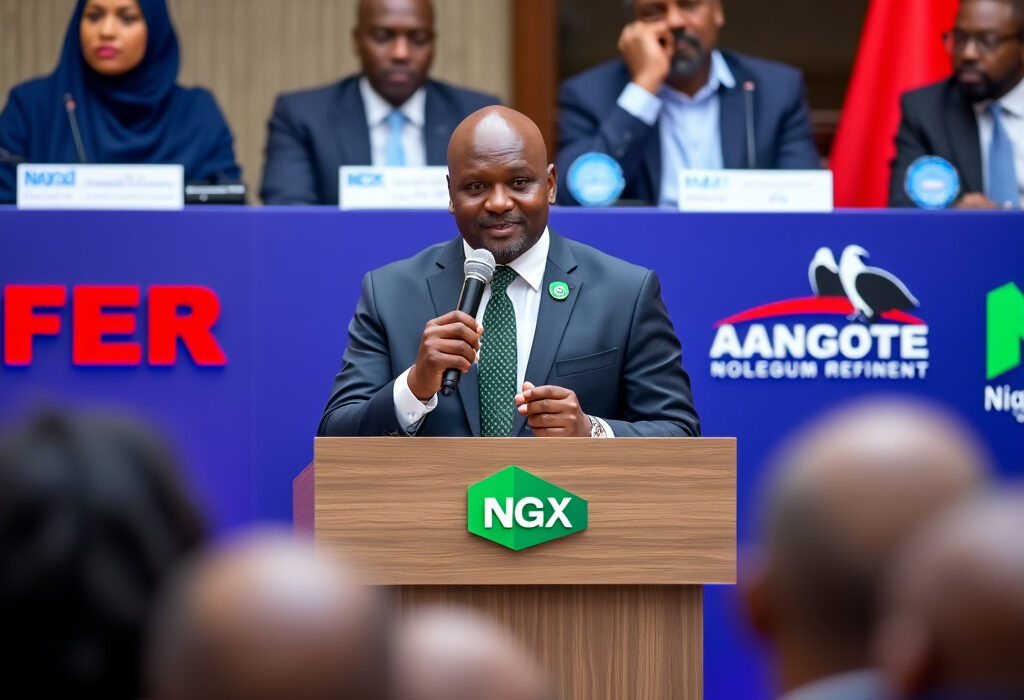
Nigeria‘s stock market is experiencing its most liquid period in recent years, with record capital raises by banks and a significant upcoming initial public offering (IPO) by the Dangote Refinery. The refinery aims to raise $1.62 billion, nearly half the total raised by Nigerian banks over the past two years, marking one of the largest liquidity events in local market history.
This milestone is particularly important for Nigeria’s startup ecosystem, which has long struggled to provide credible exit routes for venture capital (VC) investments. While mergers and acquisitions remain the dominant exit method across Africa, Nigeria has yet to see a VC-backed startup go public. The Dangote offering could signal the emergence of sufficient local capital to support public market exits for startups.
Significance of local capital for startup exits
Historically, Nigerian startups have relied mainly on private sales or additional funding rounds to provide liquidity for investors. The scarcity of venture-backed IPOs limits the opportunities for founders and investors to realize returns within the Nigerian market. The Dangote Refinery IPO, by attracting substantial retail and institutional investment domestically, could demonstrate the availability of a deep pool of Nigerian capital at the later stages of startup lifecycles.
Market infrastructure supportive yet underutilized
Nigeria’s stock exchange (NGX) offers dedicated platforms such as the Growth Board and Technology Board to facilitate listings by smaller and tech-focused companies. Furthermore, the Nigerian Startup Act includes provisions to encourage public listings. Nevertheless, awareness and understanding among startup founders about local listing processes remain low, dissuading many from pursuing IPOs.
Further challenges include valuation difficulties owing to investor preference for traditional financial metrics that may not align with high-growth tech business models, as well as the currency risk associated with naira depreciation, prompting many startups to raise capital in US dollars.
Dangote IPO as a blueprint for future exits
The Dangote Refinery’s forthcoming IPO is structured as a large-scale liquidity experiment, offering 4.1 billion shares and targeting 10 million retail investors through digital platforms. Nigeria currently has about 2.7 million retail investors, but previous public listings, such as MTN Nigeria’s share offer, have attracted large retail participation.
A successful Dangote IPO could increase the NGX’s market capitalization by roughly $60 billion, approaching a total of $200 billion, albeit with notable concentration risk as a single company could represent about one-third of the market.
By establishing a more expansive and diversified investor base, the Dangote offering may create a favorable environment for other large Nigerian startups like Flutterwave to consider IPOs. Although mergers and acquisitions are expected to remain the dominant exit route — as is common globally — the development of deeper public markets offers an alternative pathway and signals growing maturity in Nigeria’s capital markets.
Overall, the Dangote Refinery IPO represents a critical development, potentially unlocking new liquidity options for Nigerian startups and demonstrating the growing appetite and capacity of local investors to support homegrown enterprises to maturity.



0 comments
Be the first to start the conversation.