
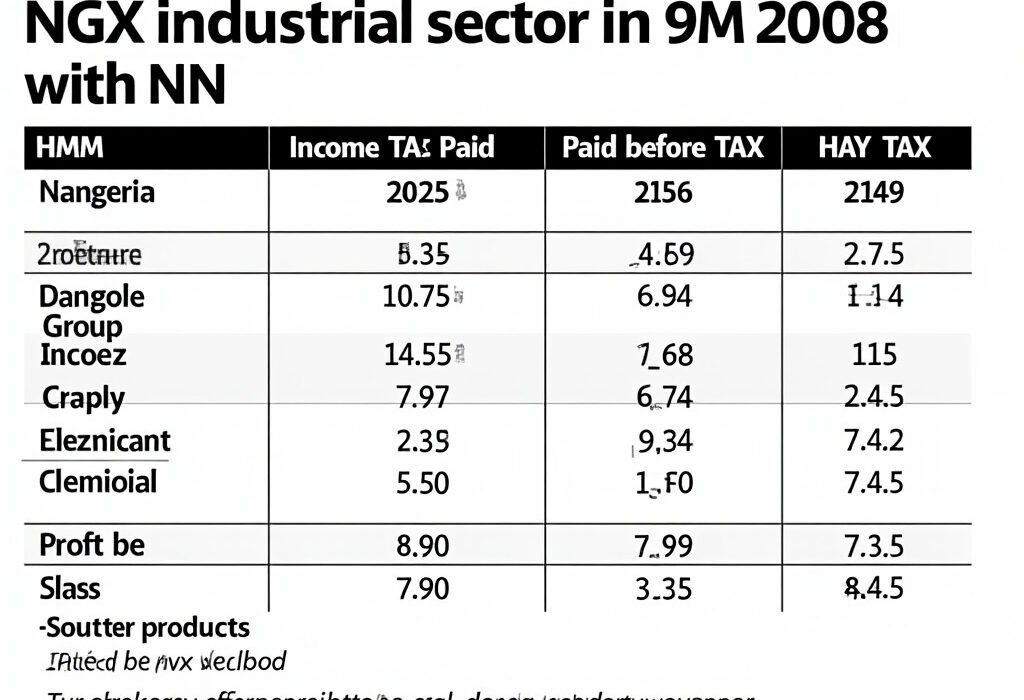
Nigeria’s industrial goods sector witnessed a significant surge in income tax payments in the first nine months of 2026, reflecting a combination of stronger company profitability and the implementation of new tax laws.
Seven of the 11 companies listed under the Nigerian Exchange (NGX) Industrial Goods sector reported a combined income tax payment of ₦271.7 billion, nearly doubling the ₦136.6 billion paid during the same period in 2025. This 98.88% increase aligns with a 43.07% rise in pre-tax profits, which grew from ₦1.74 trillion to ₦2.49 trillion.
The companies analyzed include notable firms such as Dangote Cement, BUA Cement, HBM Nigeria, Beta Glass, Chemical and Allied Products, Meyer Plc, and Berger Paints. The figures highlight improved operational efficiencies, higher sales volumes, and better profit margins across the sector.
Impact of new tax laws
The notable growth in tax contributions is influenced by the Nigeria Tax Act 2025, which came into effect on January 1, 2026. The new legislation seeks to unify multiple tax charges and streamline tax administration to enhance compliance. Under this act, the corporate income tax rate is set at 30% for standard corporations, while qualifying small businesses remain exempt. Additionally, a consolidated 4% development levy replaces several previous levies, such as those for tertiary education and technology development.
The tax framework also introduces a 15% minimum effective tax rate for large domestic companies and multinational enterprises based on their turnover. These reforms have contributed to the increase in tax payments by listed industrial goods companies in Nigeria.
Leading contributors
HBM Nigeria was the top income tax contributor among the group, paying ₦131.51 billion, marking a 1,154% increase from ₦10.49 billion in the prior year. This corresponds with a 32.28% increase in its pre-tax profit to ₦414.43 billion. The company increased its revenue by 18.9% to ₦928.25 billion and improved operating profit by 28.2%, benefiting from higher sales volumes and effective cost management.
Dangote Cement, despite a 15.3% decrease in tax paid to ₦97.74 billion from ₦115.40 billion previously, experienced a substantial 41.45% rise in pre-tax profits, reaching ₦1.47 trillion. The variation in tax payments is linked to expired tax holidays and the application of the new development levy.
BUA Cement also showcased strong results, with income tax payments soaring to ₦29.48 billion from ₦2.35 billion and pre-tax profits rising by 64.43% to ₦556.70 billion. The increase in tax payment reflects moving out of a low-tax period alongside improved operational profitability.
Sector-wide implications
These developments indicate a strengthening Nigerian industrial goods sector with increased profitability and growing government revenue from corporate taxes. The higher tax contributions can support national development programs funded through the consolidated development levy and other fiscal initiatives.
Overall, the increase in income tax payments underpinned by improved business performance and updated taxation policies highlights Nigeria’s evolving economic landscape and the growing role of its industrial sector in national revenue generation.

0 comments
Be the first to start the conversation.